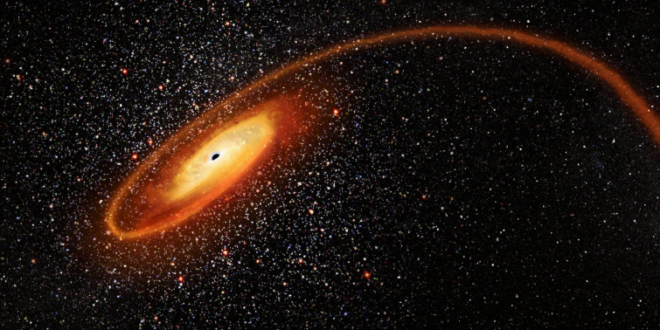
Imagine floating in the deep void of space, surrounded by a silent sea of brilliant, non-twinkling
stars. Suddenly, your eyes are seized by a strange anomaly: a sphere of absolute darkness,
wrapped in a whirling carnival of light—a black hole, one of the universe’s most enigmatic
phenomena.
A black hole is a region in space with gravity so intense that nothing, not even light, can escape.
Most form when massive stars die, collapsing under their own weight until their entire mass is
crushed into an infinitely tiny point called a singularity.
While the hole itself is invisible, we can detect its presence indirectly. Scientists observe the
high-energy radiation from its surrounding accretion disks —a superheated maelstrom of gas
and dust spiraling inward—or by measuring the ripples in spacetime created when black holes
collide. For instance, Professor Andrea Ghez, won the 2020 Nobel Prize in Physics for
discovering a black hole at the heart of the Milky Way galaxy, by tracking stars whirling at
unimaginable speeds around an invisible center.
Why does this matter? Beyond their cosmic allure, black holes are natural laboratories for
testing the laws of physics under the most extreme conditions. Studying them challenges our
understanding of both gravity and quantum mechanics, pushing us towards a deeper theory of
how the universe works.
From the wild imaginations of people a century ago to a tangible image we can all see today,
humanity’s journey to comprehend black holes marks a monumental leap in science. With
growing global collaboration and a new generation of curious minds, we are steadily pulling
back the veil covering the cosmos’ deepest secrets.