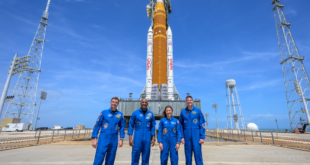
On April 6, 2026, NASA’s Artemis II mission achieved one of the most significant milestones in the history of human spaceflight. The mission — the first crewed flight beyond low Earth orbit since Apollo 17 in 1972 — carried four astronauts aboard the Orion spacecraft, named Integrity, on a ten-day lunar flyby.
Six days into the mission, at 12:56 p.m. CDT, the crew surpassed the record for the farthest distance any human has ever traveled from Earth, previously held by the Apollo 13 mission since 1970. The spacecraft reached its peak distance of 252,756 miles from Earth at 7:02 p.m. ET — putting it more than 4,100 miles beyond the Apollo 13 record.
The crew making history is no ordinary one. Victor Glover became the first person of color, Christina Koch the first woman, Canadian Space Agency astronaut Jeremy Hansen the first non-U.S. citizen, and Commander Reid Wiseman the oldest person to travel beyond low Earth orbit and near the Moon.
The momentous day culminated in a seven-hour lunar flyby — the first time humans had returned to the Moon’s vicinity since Apollo 17 in 1972. During the flyby, the crew observed geological features on the lunar surface from a closest approach of about 4,067 miles above the surface, capturing imagery and scientific data that NASA scientists were eagerly awaiting.
One of the most dramatic moments came when the spacecraft passed behind the Moon, plunging into a communications blackout with Mission Control. The blackout was among the longest in human spaceflight history, lasting roughly 40 minutes. During this time, the crew witnessed an “Earthset” — the moment Earth dropped below the lunar horizon — before emerging on the other side to see an “Earthrise.”
The mission also delivered a rare scientific treat. As Orion passed behind the Moon, the crew entered a solar eclipse, giving them the opportunity to observe the Sun’s corona glowing around the lunar edge and watch for meteoroid flashes on the lunar surface.
NASA described the mission as more than a record — it is a foundation for the agency’s ambition to establish a permanent Moon Base and eventually reach Mars. As Commander Wiseman put it after emerging from the far side of the Moon: “We are excited to watch this nation and this planet become a two-planet species.”
The crew is scheduled to splash down off the coast of San Diego upon completing their roughly 10-day, 695,000-mile journey. For now, Artemis II has reminded the world that humanity’s hunger for exploration is very much alive.