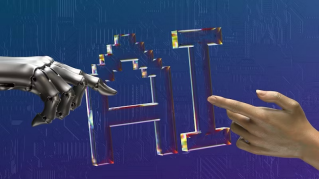
Nowadays, AI is advancing rapidly. Cities are filled with new technology—for example, almost everyone has an AI app on their phone and uses it daily. We also use machines instead of workers for production. AI brings people much efficiency and convenience. However, some still worry that AI will one day replace many human jobs, leaving people unemployed. So, how will AI change future jobs? Here are my perspectives.
In my opinion, the future can be divided into two stages. The first stage will occur over the next 10 to 20 years. AI will take over some boring, repetitive work, such as housework, package delivery, street cleaning, and tree cutting. But I believe new needs will arise. Some of those replaced will find other jobs. It will be similar to the invention of high-speed trains. In 1964, when the high-speed train was launched, it seemed like a strange invention. Due to the efficiency of the Shinkansen in Japan, labor disputes emerged. Unions worried that the new system would reduce the number of workers. Before, many simple trains were needed to carry people; afterward, only one high-speed train was required. This meant that the number of staff and routine traffic decreased. Yet, the high-speed train created new interesting jobs, such as onboard mechanics and ground service technicians. It created more opportunities, so those who were unemployed eventually found work. AI in the next 10 to 20 years will be like the high-speed train in 1964. Both improve efficiency and reduce costs. Rather than reducing employment, AI will likely expand the job market.
The second stage will come after 20 years. By then, in my view, almost all jobs—except those involving AI development and ownership—will be taken over by technology. Many who lose their jobs may stay at home with nothing to do and no income. Prices of goods may fall dramatically, leading to new issues. Savings will eventually run out, and some may face bankruptcy. So, how can this problem be solved? Governments will likely recognize the issue and introduce laws and regulations to help. AI owners may need to pay an “AI tax. ” That means if someone owns a significant amount of wealth, energy, or robots, they must contribute a portion to the government. The state would then redistribute these resources to poor people. This action would help redistribute wealth and ensure a basic livelihood for everyone—much like “dividing the cake.”
Initially, the cake is divided according to contribution: those who work harder, have special skills, or provide capital get larger pieces. To prevent hunger, the government acts as a fair distributor, sharing the resources it collects with the elderly and the poor through social security. Additionally, people will have access to free education. They can study full-time or with books to improve their knowledge, and perhaps one day find new jobs. Their children will also be able to attend classes and pursue their dreams. At that time, education may become the key to moving up the social ladder. Another issue is that unemployment could lead to increased crime. My prediction is partly based on a real story: in November 2024, a 34-year-old woman in Singapore, unemployed and unable to afford basic necessities, was arrested for stealing groceries. In the future, we may need more AI for security and social order. If security systems are strong enough, perhaps crime rates will fall.
However, I have not considered the possibility of AI extending human capabilities. If that happens, we might use advanced computer interfaces and merge our bodies with robots. We could become as capable as machines—but that is another topic.
So, if AI does everything, what will humans do?
We will do what we have always done best: we will care, create, and choose. We will care for each other, create meaning beyond efficiency, and choose the kind of future we want to build. Let’s not wait for that future to happen to us. Let’s learn, accept, and meet it with courage. The age of AI is not the end of our story. It is the next chapter, and we are the authors.
die within a few days without TAH, the proportion of those who are successfully supported by TAH
until heart transplantation reaches as high as 70% to 80%. Second, as technology evolves, TAH may
one day permanently replace biological hearts, ending the organ shortage crisis. Beyond the heart,
electronic organs are transforming lives in every field. Cochlear implants are bringing music back
to the deaf, artificial pancreases are managing blood sugar automatically for diabetics, and bionic
eyes are helping the blind perceive light once again.Thirdly, by treating terminal diseases, it
significantly extends human life expectancy.
The TAH is more than just a scientific breakthrough; it is a beacon of hope. As the saying goes,
“The future is not something to wait for; it is something we create.” The steps of humanity
exploring the world—like this mechanical heart—will never falter. Even when the flesh fades, the
rhythm of innovation will keep beating fervently and endlessly.