By Sofia Pan, Grade 8
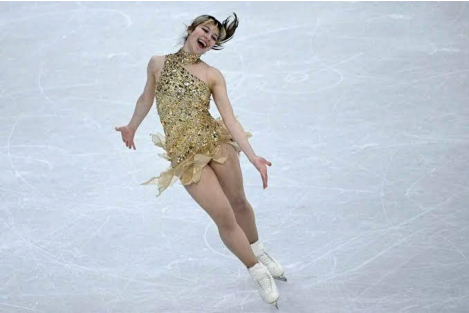
(Caption: Every winter, skaters glide across ice rinks with a grace that seems almost effortless. But beneath the elegance lies a surprising amount of science. Let’s look at two key questions: why is ice so slippery, and how do skaters spin so fast?)
Why Ice Lets You Slide
The classic explanation is that pressure from a thin skate blade melts the ice, creating a thin layer of water that lubricates the glide. That’s partially true. However, most of the real work is done by frictional heating. Have you ever noticed that the blades are not mirror-smooth? Instead, they are specialized and curved in order to balance glide with grip. As the blade moves, friction generates heat that melts the ice beneath it.
There’s also a natural layer on ice itself. Even without skates, ice is slippery because a thin, disordered layer of molecules exists on its surface—a kind of “quasi‑liquid”. This layer makes sliding possible in the first place, whether you’re on skates or just shuffling across a frozen pond. So when a skater carves across the ice, they’re balancing pressure, friction, and the strange molecular nature of the surface beneath them.
The Secret to Spinning Faster
You’ve seen it a hundred times: a skater pulls their arms tight against their chest and suddenly spins like a top. This isn’t magic—it’s the conservation of angular momentum.
When a skater’s arms and legs are extended, their mass is spread far from their center, creating a high moment of inertia (a measure of how hard it is to change rotation). When they pull their limbs inward, that moment of inertia drops. But angular momentum—the total “spin energy”—must remain constant. So to compensate, their rotational speed increases dramatically.
To achieve this, skaters often start the effect by converting their linear skating speed into rotation, using the pressure of their blade against the ice to launch into the spin.
From the molecular quirks that make ice slippery to the elegant physics of angular momentum, figure skating is a sport where science and athleticism meet. The next time you watch a skater launch into a spin, you’ll know: they’re not just athletes—they’re physicists in motion.