By Sarah, Grade 8
If you would be a real seeker after truth, it is necessary that at least once in your life you doubt, as far as possible, all things.
——René Descartes
It’s another ordinary day. I look out the window. The city streets are full of self-driving cars in the sky, moving like machines, the same speed, the same appearance. Delivery drones are extremely busy, sending different food and packages to people. This world runs in perfect order, as if it had been programmed.
My name is Sarah, and I am doing well in maths and physics. Last semester, I joined the math club, which usually talks about some interesting problems, such as the birthday paradox or how to calculate the length of a shadow. I have really enjoyed solving the triggers with my teammates.
Recently, we began studying the math behind specular reflection and were given a problem about the infinite regression regression paradox. Everyone else in my class believes that the number of images formed by two mirrors is finite, but I disagree.
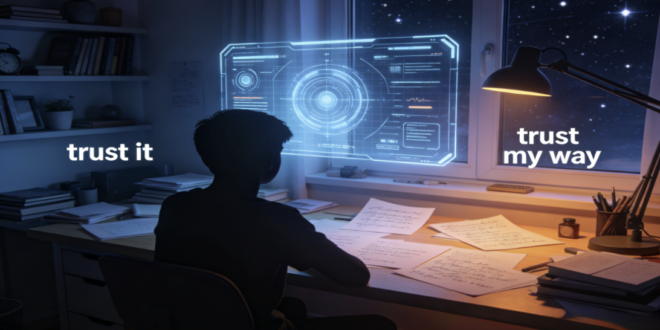
Today, I was really looking forward to joining them in doing the math problems, when he believes that discussing the problem is meaningless and that arguing with my teammates will increase my stress because I hold a different perspective. To persuade me, he creates a form, saying these body changes will happen if I join:
Cortizo 22.5mg/dL(predict the pressure peak)
sleep lose forty minutes
heart rage 110~130beats/min(influence leaving conditions
After a full day of studying, I feel really tired and didn’t have the energy to think about the importance of the meeting, so I just agreed with Tim. My past life experience and intuition tell me that Tim is always right, and I trust him completely.
Why do I trust it so much? Because the specificity and accuracy with which he arranges things is shocking. For example, for today’s dinner, Tim used the automatic cooking terminal, which matched 12.5g of high-quality protein and 300mg of Omega-3 based on my morning blood oxygen saturation. For the math competition practice, Tim used a heuristic algorithm to eliminate all problems with redundant logic for me, improving efficiency by 315%.
Both fortunately and unfortunately, after this meeting, my teammates found out my opinion on the problem was right. This incident reminds me of the famous scientist Copernicus. Back then, the scientific community widely believed that the Earth was the center of the universe, the geocentric model. When he questioned that the geocentric model was complicated, scientists around the world looked down on him, thinking he was stupid. However, through a series of precise mathematical deductions and model calculations, he proved that the heliocentric theory was actually correct. The difficulty I face is just like Copernicus’s, but I do not persist, nor do I carry out further exploration. I only stopped at the stage of putting forward my opinion.
Overall, I think Tim is the reason why I stopped exploring the world and also it is the difference between people and AI. AI only focuses on improving efficiency and getting more things done, while real scientists explore, experiment, make mistakes, and innovate.
AI is designed to find the answer, but humans are designed to ask the question. For it is only when we dare to doubt the ‘perfect’ conclusion that we begin to find our own truth.