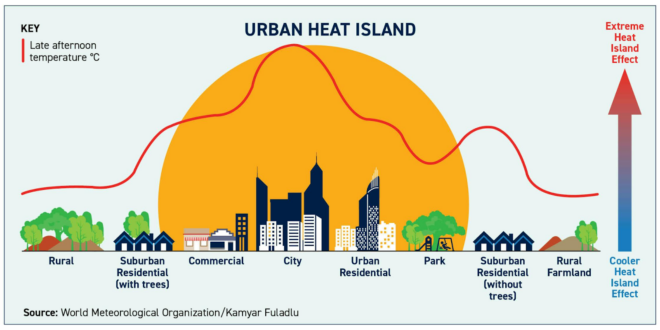
Have you noticed that summers feel hotter than they used to? It’s not just your imagination, and it’s not only because of climate change. If you live in a city, there’s another reason your neighborhood heats up faster than the countryside around it. It’s called the urban heat island effect, and it’s making city life increasingly uncomfortable and even dangerous.
More than half of the world’s population lives in cities, and urban areas tend to experience higher average temperatures and more intense heat than less developed areas. Why? Because cities are filled with concrete, roads, and buildings that absorb heat during the day and release it at night. There are also far fewer trees and green spaces to cool things down.
The difference in temperature can be huge. On a 96°F day in rural northern Texas, someone living in a Dallas neighborhood with a high urban heat island index could experience temperatures of at least 105°F. That’s nearly 10 degrees hotter, just because of where you live in the city.
And it’s not affecting everyone equally. According to a 2021 study, people of color and people living below the poverty line are more exposed to urban heat island intensity in 169 of the largest U.S. cities. Neighborhoods that were historically neglected have fewer trees, more pavement, and less access to cooling, making extreme heat a matter of fairness, not just weather.
Heat wave counts and heat wave season length have steadily increased in U.S. cities over the past several decades, and as global temperatures continue to rise, heat waves are expected to become even more frequent and severe. Extreme heat is already the deadliest weather-related hazard in the United States, more deadly than hurricanes, floods, or tornadoes.
The good news is that cities can fight back. Planting more street trees can lower pedestrian-level temperatures by 1–2°C, and locations with no tree cover nearby were up to five times more likely to exceed dangerously high temperatures. Cool roofs, rooftops painted white or coated with reflective material, can also cut temperatures significantly. These strategies don’t just cool cities down; they also reduce energy use for air conditioning, lower greenhouse gas emissions, and even reduce flooding risks during heavy rain.
Our cities are getting hotter. But the solutions already exist: more trees, smarter buildings, and greener streets. The real question is whether we act fast enough to use them.