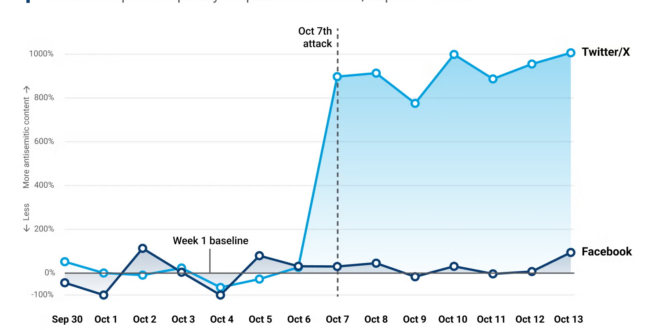
When Hamas launched its attack on Israel on October 7, 2023, the violence did not stay contained to the Middle East. Within days, a parallel wave of hatred surged across the internet — and it has not fully receded since.
Researchers at the Institute for Strategic Dialogue documented an over 50-fold increase in the absolute volume of antisemitic comments on YouTube videos about the Israel-Palestine conflict following the Hamas attacks, with the proportion of antisemitic messages rising by more than 240% during the same period. The spike was not limited to one platform. Cross-platform monitoring showed increased online threats against Jewish communities across both mainstream and fringe social media, taking various forms through graphic imagery and direct calls for violence.
The numbers tell a grim story. The Anti-Defamation League’s 2024 audit found that antisemitic incidents in the United States increased from 942 in 2015 to 9,354 in 2024, with a particularly sharp spike between September and October 2023 — rising from 513 to 1,813 incidents in a single month. Online search data reflected the same disturbing trend: Google searches for phrases like “Kill Jews” spiked sharply in the week following the October 7 attack.
Social media algorithms have played a significant role in amplifying the hatred. Platforms are designed to prioritize content based on user engagement, which means that outrageous posts — including hateful ones — get rewarded with greater visibility, incentivizing users to contribute more extreme content. The problem has spread globally. In China, social media platforms were flooded with antisemitic content and conspiracy theories, including Holocaust denial, while in Brazil, a wave of antisemitic rhetoric spread online after the country’s president compared Israel’s actions in Gaza to the Holocaust.
The consequences have extended well beyond screens. Data from monitoring organizations reveals a drastic rise in antisemitic narratives across social media, often linked to misinformation, disinformation, and radicalization, and researchers note that the frequency of antisemitic incidents in real life closely tracks online activity. A Tel Aviv University report found that 2025 saw the highest number of Jews killed in antisemitic attacks in more than three decades, with 20 people murdered in four separate incidents.
The EU’s Agency for Fundamental Rights warned that “the spillover effect of the conflict in the Middle East is eroding hard-fought-for progress” in combating antisemitism, with Jewish communities across Europe reporting that Jews are “more frightened than ever before.” As one researcher put it, the data raises serious concern that a historically elevated level of antisemitic incidents is becoming a normalized reality — a warning that demands attention far beyond the platforms where the hatred originates.