By: Evan Shi Grade 12
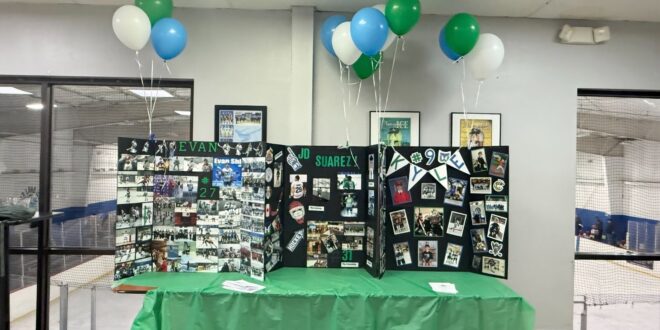
My varsity hockey team’s senior night is coming up and for it, the other seniors and I have to create a trifold with photos illustrating our hockey experience over the years. I spread out four years of team photos on the table in our living room, and I barely recognize half the faces staring back at me from freshman year. Players who felt like permanent fixtures have graduated and moved on, and the moments that felt monumental have faded into hazy memories. I start to wonder: Similar to the way I once looked up to the imposing older players in the corner of the locker room my freshman year, will the current freshmen remember me as a senior?
That’s when Coach Taylor Mullen’s words finally made sense. Since my freshman year, he’s told us to “enjoy the time you have on the team because it doesn’t last.” I never understood what he meant beyond the literal. Now as a senior, I do.There are two answers, and both have stayed with me.
The People Will Last
A hockey team operates in cycles. New players come in while seniors leave. Those in the middle advance, carrying forward the stories and traditions of those who came before, transmitting them to the younger players. Soon, those in the middle become seniors themselves, and their time comes to be passed down. We still talk about Fraser, who played six years ago and now plays semi-professional hockey. He was the best player in our team’s history, and his story gets passed down to every new class. My sophomore year, after we won City and State Championships, we had a tradition where the team got to shave our coach’s beard, as weird as it sounds. New players still talk about that moment, and still laugh about it. So, when I hosted the team’s alumni event this year, I wanted to improve on last year’s disaster where our only scheduled alum dropped out at the last minute. Being on the team the longest, I knew we had a rich history stretching back to the 1990s when our league was created. I spent countless hours tracking down former players with only their names and graduation years through league archives, coordinating through text messages and old coach contacts. I remember standing in front of the rink door minutes before the alumni were set to arrive, nervous about whether anyone would actually show. Then they started coming. Hugging players I hadn’t seen in years. Watching them fall back into old jokes. One alum I’d coordinated with texted me after: ” And thank you for having us, it was a blast.” We talked about the team bond, about his experiences with players I’d also played with, about how the connections don’t fade even after you graduate.
These alumni deemed the team an extended family. They remembered the wins, the late-night dinners after games, and most importantly the bonds formed on ice. My current teammates will become lifelong friends, and they’ll spread my story and our traditions to future players. Hockey demands this kind of bond. It’s one of the fastest and most physical sports. You have to trust your teammates completely and look out for each other to make it work. That trust stays.
Regret Will Last
There’s a specific game from my sophomore year that still haunts me. A player on the opposing team beat both defensemen. We were skating as fast as we could to catch up to this guy on a breakaway. He shot. Rebound. He took it up again and shot. Another rebound. Our goalie made five or six desperate saves in a row, each one more improbable than the last. I was there in those final moments. My legs slowed, and I became a spectator, watching the moment from the sideline instead of acting. I told myself something would happen before I arrived; The goalie would hold it, or the guy would score anyway. But he didn’t score right away, and I could have done something. I could have tied up his stick or disrupted the rebound. Instead, I just coasted.
Eventually, he scored. It wasn’t a championship game. It wasn’t even a playoff game. Just a regular-season game that most people have forgotten. But I remember it vividly because that regret lives within me. Years later, I still feel guilty knowing I could have changed that moment but didn’t. But the regret isn’t just about that one play. It’s about all the other moments I didn’t fully show up for. There was a team dinner my junior year, during the state tournament. I was tired. I made an excuse and went back to the hotel instead. At the time, I thought there would always be another dinner. Another chance to sit around a table with teammates, trading stories and talking about nothing important. I didn’t recognize I was missing out on something until those moments were already memories, and the teammates who might have carried my story forward had graduated. We always say “leave everything on the ice.” I think that goes for any sport. It means maximizing your effort in the moment, but it also means maximizing your experience with teammates and friends. Don’t regret not doing something. Don’t regret not putting in 110% of the effort, both on and off the ice.
What I Finally Understand
After senior night, I stayed in the locker room. A couple of freshmen were still there, and I asked them, half-joking, “Will you remember me?”
“Yes, of course,” they said.
Delusional or not, I wanted to believe them so much. But I also knew that four years from now, when they’re creating their own trifolds, some faces will have faded. Some moments will blur together. That’s just how it works; not just for the team, but for life. My trifold spans my entire hockey career, from the teams I played on when I was three years old to Memorial West, with photos from freshman year through senior year. All the faces, all the moments. As I arrange these photos, I truly understand what Coach meant. He wasn’t just telling us to recognize the moment. Recognizing that something won’t last doesn’t mean much if you’re not doing anything worth remembering. What matters is creating experiences that will stay with you, building connections that endure, giving effort you won’t regret. It’s doing things you’ll actually want to remember while understanding you won’t get another chance. The people will last. Their stories, traditions, and bonds echo forward through generations of players. But so does regret on the other end. The moments where you held back, where you didn’t give everything, where you let opportunities pass because you thought there would always be more time. I realize that the coach was right. This doesn’t last, but you can do things that do.