By Sofia Pan, Grade 8
You’ve probably heard the story of Frankenstein—a scientist who created a hideous creature from dead matter. But that story might no longer be fiction. Instead of stitching corpses, researchers today are printing hearts and building living organs from scratch—this time, for a good cause. Here’s how Frankenstein’s dream unfolds.
Currently, there are over 100,000 people on organ transplant lists in the U.S. Some will have to wait years for a donation; others will not survive the wait. And even when an organ becomes available, the recipient’s body may reject it. To address these challenges, researchers have pursued 3D-printed organs—hoping to create a future where no one dies waiting.
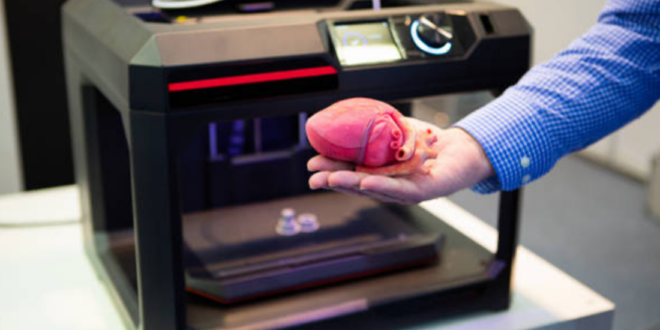
The process begins with removing a small piece of tissue from a patient’s organ. Scientists separate the cells and place them in a bioreactor—a pressurized stainless steel vessel that mimics the human body’s temperature and oxygen levels—allowing them to multiply. These cells are then mixed with a gel to create bioink: a mixture of living cells, hydrogels, and nutrients. Loaded into a 3D printer, the bioink is deposited layer by layer, gradually building a functional organ.
The revolutionary achievement was built on decades of incremental breakthroughs—layer by layer. Before 1988, printing organs was unimaginable. That year, Dr. Robert J. Klebe demonstrated “cytoscribing”, the first bioprinting experiment. In the 2000s, researchers began attempting to create vascular structures. Then in 2009, the first spark of life was seen: Organovo, the world’s first commercial bioprinting company, created the first 3D-printed blood vessel—without using a scaffold.
But printing a single vessel was only the beginning. The real challenge? Building an entire network of them inside living tissue—and keeping that tissue alive. Layer by layer, Frankenstein’s dream progressed.
In 2014, Jennifer Lewis’s team at Harvard achieved a breakthrough: they printed tissue containing functional, perfusable blood vessels using a “disappearing ink” technique. For the first time, 3D-printed blood vessels existed within living tissue. The creature finally had veins.
Further advances in microfluidic bioprinting followed, and in 2019, Tel Aviv University printed the first 3D heart with blood vessels—complete with cells, ventricles, and a vascular network (though only rabbit-sized).
Then came 2025. Researchers at Stanford developed an AI algorithm that designs vascular networks 230 times faster than previous methods. Meanwhile, Utrecht University’s GRACE printer used computer vision to “see” cells and design vessels around them in real time. This year, 2026, brought two major accomplishments: UT Southwestern’s VITAL project, a $25 million initiative to print functional livers, as well as MIT’s MagMix, a device that solves the cell-settling problem that long plagued consistent printing. These breakthroughs are paving the way for scalable manufacturing—meaning that one day, 3D-printed organs could be available in hospitals worldwide, saving countless lives.
Two centuries ago, Mary Shelley imagined this story. Today, we are living it. We stand at the same threshold Victor Frankenstein once crossed—but with one crucial difference: we have time to reflect upon the question he never did. Will we recreate the tragedy?
The printer is humming. The cells are growing. We have the power to create life—to print hearts that beat, livers that filter, and vessels that pulse. But we also have the chance to do what Victor Frankenstein could not: to take responsibility. The future is being built, layer by layer. This time, let’s make sure we get the ending right.