By: Sarah Grade 8
If laughter, wind sounds, and other noises cannot compete with the short video soundtrack that plays every 30 seconds, are our children living in reality or trapped behind a 5-inch screen?
Nowadays, short videos are extremely popular, and a large number of people are addicted to them. Here are some unbelievable yet unavoidable facts. As of 2026, TikTok’s end users number up to 2 billion per month worldwide, which means 23% of the population uses TikTok every month. In China, the average daily time spent on short videos per user exceeds 2.5 hours.
Some people may think that short videos are merely a simple form of entertainment. How could it possibly be so addictive? What harm could it truly inflict? In fact, it is as addictive as smoking or drinking. Let me explain the underlying logic, and then you will understand.
Initially, all the short videos are sorted by platform, such as food, animals, sports, and so on. The platform will score every video based on your watch time, likes, comments, and shares. Then, using those scores, the platform will decide whether to recommend videos similar to it.
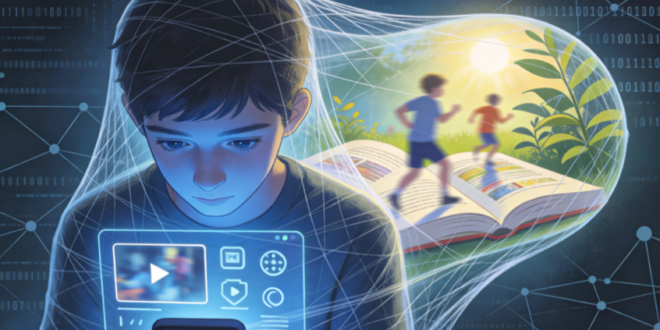
The platform is like a luxurious cocoon tailored just for you. It keeps playing what you like and making you addicted and unable to break free.
Powerful algorithms affect teenagers a lot today. First, since short videos are very short, our concentration will be short, so that the mind will “cut into small pieces” after a long time, you will find it very easy to lose focus, and you can’t concentrate on the teacher even after a minute or two. You will feel that studying is so boring that you only want to play on your phone. Second, a short-form video platform only shows you the content you enjoy, so during that time, you can only see the scenes you like. Your vision will be extremely narrow, like a worm trapped in a cocoon, not knowing what is happening in the outside world. We all know teenagers living in this age need to have a broad vision, an open mind, curiosity about new things, and a habit of continuous exploration. But shorter videos go against this idea, they are high-frequency, short, and easy to grab interest or knowledge. It makes the brain get used to easy pleasures, and teens will be unwilling to think deeply about solving difficult math problems, reading long novels, or managing a big project. Here is a real example: Leo used to be a straight-A student, but after becoming addicted to “oddly satisfying videos” and “gaming highlights” on TikTok, his GPA decreased from a perfect 4.0 to 2.5 within a single year. experts call it “cognitive jumping,” which manifests as a physical sense of discomfort whenever he tries to read more than three pages of a literary classic. Having grown accustomed to a fresh burst of stimulation every 15 seconds, he now suffers from “brain fog” when facing long-form text, finding it nearly impossible to establish logical connections. His mind has been conditioned for “scanning-based reading” rather than the “deep, immersive reading” required for academic success.
However, there are still some things we can do to break the information cocoon and let teenagers trapped inside see the world again. In December 2025, Australia prohibited students under 16 from using social media. This includes TikTok, Instagram, X, and YouTube.If you think banning social media outright is too radical, you can also use Teen Mode to limit the types of videos you can watch and their timing. But I think self-control is the most important thing. Teenagers should know the harm of short videos, and they should control themselves. Only this can solve the real problem.
In the age of algorithms, we must ask ourselves: are we the masters of our tools, or the harvest of their data? The ‘information cocoon’ is not just a word; it is a silent erosion of our capacity for deep thought. If we allow the 15-second entertainment hit to replace the slow beauty of contemplation, we are losing the very thing that makes us human—the freedom to choose what to think. To break the cocoon is not to reject technology, but to reclaim the liberty of our own minds.