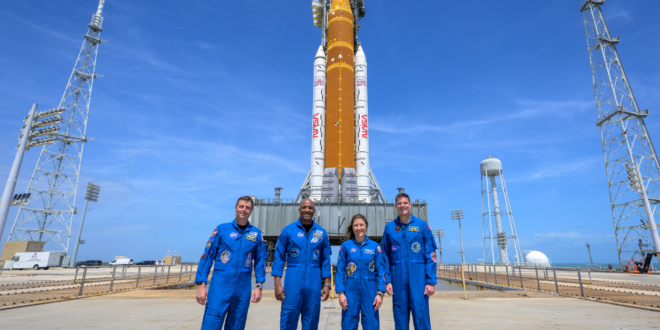
For the first time in over half a century, humans are on their way to the Moon. NASA’s SLS rocket lifted off from Launch Pad 39B at Kennedy Space Center in Florida on Wednesday at 6:35 p.m. EDT, carrying four astronauts aboard the Orion spacecraft on a planned test flight around the Moon and back.
The crew consists of NASA astronauts Reid Wiseman, Victor Glover, and Christina Koch, along with Canadian Space Agency astronaut Jeremy Hansen. Together, they represent the first humans to travel beyond low Earth orbit since the Apollo era. The mission, which the crew named “Integrity,” is planned to last approximately 10 days.
The flight plan is ambitious. About 49 minutes after launch, the rocket’s upper stage fired to place Orion into an elliptical orbit around Earth, and a second burn will push the spacecraft into a high Earth orbit extending roughly 46,000 miles from Earth. From there, if systems check out, mission controllers plan to execute a translunar injection burn on Thursday, April 2 — a roughly six-minute firing that will send the crew looping around the Moon while using lunar gravity to slingshot them back toward Earth.
One of the mission’s most anticipated moments comes Monday, April 6. During a planned multi-hour lunar flyby, the astronauts will photograph and observe areas of the Moon’s far side — becoming the first people ever to lay eyes on some of those regions.
Beyond the spectacle, Artemis II has serious scientific goals. The mission will demonstrate life support systems for the first time with a crew aboard, and human health investigations conducted during the flight will inform planning for future lunar surface missions. Following the lunar flyby, the crew will return home and splash down in the Pacific Ocean. The Moon, it seems, is no longer out of reach.