By Sarah Zhu, Grade 8
Imagine, the skyscrapers stand like a forest, nestled close to one another. The towering buildings before us reach straight into the clouds, and the sunlight reflected off the glass makes the world fresh and bright. Self-flying cars zip through the skyEverything is running in perfect order. In a small cafe, a robotic person meets a humanoid machine? What would they say?
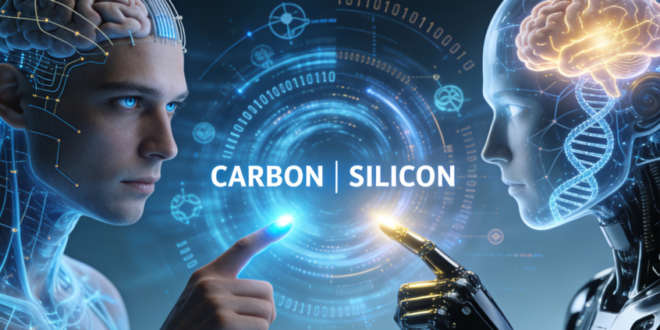
Nowadays, AI is booming rapidly. Following the trend of the times, I found an interesting pattern: Silicon-based life is drawing closer to carbon-based life, and carbon-based life is also moving toward silicon-based life.
First, let’s talk about Silicon-based life to carbon-based life. Tesla’s Optimus represents the embodied intelligence and is a typical example of the in-depth evolution of silicon-based entities toward carbon-based life. Abandoning the rigidity of pre-programmed traditional robots, it adopts a full-vision neural network identical to that used in Tesla vehicles. This means it, is no longer a machine that merely accomplishes tasks; instead, it learns through “observation” just like humans do. By simulating human joints and senses, it can perform delicate tasks such as folding clothes and grasping eggs.
Meanwhile, Groq and NVIDIA are also working on something fascinating: they are redesigning the internal architecture of chips so that data no longer waits in queues to be processed. Instead, data flows through the chips in instant parallelism, much like brain waves. Put simply: Traditional chips were like cold-blooded accountants, only good at calculation. Modern chips, by contrast, are more like athletes with lightning-fast reflexes. They no longer focus on extreme precision, but instead aim to develop an intuition similar to a conditioned reflex—just like the human brain, which forms instant responses the moment it receives information. Humanity is striving to “recreate itself”.
On the other hand, carbon-based life is also moving toward silicon-based life. Neuralink, which is also a subsidiary of Musk‘s company, like Tesla, is developing a new technology called a brain-computer interface (BCI). The thing is not that difficult. Initially, we need to cut a 25 mm pole on the top of your head. Then, implanted every 1.5 seconds. After waiting 128 times, the surgery is done. It means you will have a super mind: you don’t need to remember things, you don’t need to talk, or even your body. Just think about what machines can do for you. It is really useful in daily life, especially in medical technology. Noland Arbaugh, who is a patient with severe paralysis, once implanted a BCI and now can sleep in bed and play computer games with his father.
A team led by Swiss scientist Grégoire Courtine has achieved an even more impressive breakthrough: enabling paraplegic patients to stand and walk again. They implanted sensors in the patients’ brains and at the site of spinal cord damage. After 12 years of paralysis, Dutch patient Gert-Jan Oskam used this system to allow signals from his brain to bypass the severed spinal cord and directly control his leg muscles. He can even walk up slopes and stand at a bar to have a drink with friends.BCI has indeed brought great convenience to people. Maybe in the future everyone can keep all the information in the world in mind, so that everyone is as clever as a robot, even better than it.
Back to the first question, will humanoid machines control the world? Well, I don’t think so. Here are several reasons.
To be continued…